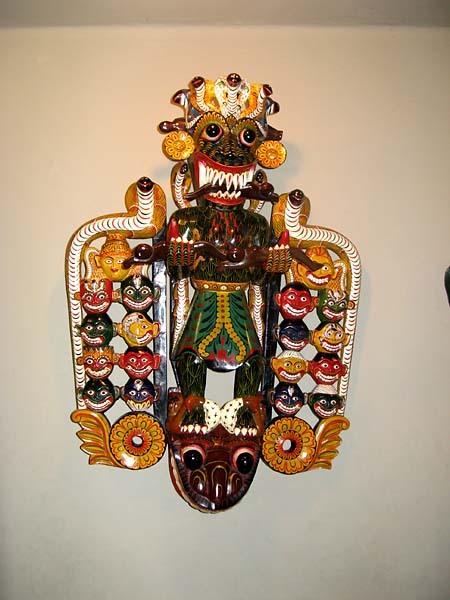
Nowadays in Sri Lanka, masks are used in dramatic adaptations, dance performances, various rituals and also to cure sicknesses (according to ancient beliefs). There are different types of mask categories that are used in Sri Lanka which includes;
Masks of endless style have been worn worldwide since antiquity to provide physical and psychological transformation of character. Sri Lanka has a distinctive mask heritage, and enjoys a living tradition in mask dance-drama: dozens of types of mask, many bizarre, are used in spiritual, secular, magical and even exorcism rituals.
Part the veils of time and legend and you would probably find an island inhabited by several self-described clans, the largest called the Yakkas, ‘demon-worshippers’, another the Nagas, ‘snake-worshippers’, in particular the cobra. More mythical were the Rakshasas, who were shape-changers. These clans, whether they existed or not – and there is reason to believe the first two did – have had a profound impact on the evolution and symbolism of masks in Sri Lanka.
After the ‘disappearance’ of the Yakkas, early travellers visiting the Island related tales of how the inhabitants worshipped demons believed to live in trees. These demons, called yakkas of course, were worshipped in a quest to pacify them, to avert their evil forces, and the participants wore fearsome masks with a devilish face festooned with cobras.
The ancient history of the art of masks in Sri Lanka is inevitably shrouded, although it is believed to have originated in the South Indian state of Kerala, where the raw material used was palm leaves. When the tradition filtered to Sri Lanka and took hold in the South, in particular the coastal town of Ambalangoda, the soft, balsa-like wood of the strychnine tree (Strychnos nux-vomica), known as goda kadura, became the substitute material.
Over the centuries, mask forms evolved for differing mask-drama, yet yakkas often lurked. In the award-winning children’s novel Mythil’s Secret (2009), Prashani Rambukwella explores the belief in yakkas and the influence of masks through the eyes of a young boy, Mythil: “Quite suddenly the fruit seller looked straight at him – with the face of a yakka! He had glowing red eyes and tiny tusks protruding from under his upper lip.”
When Mythil is rescued from two yakka spirits they turn into pale blue ghosts and he realises “the only substantial thing about them were their masks”, in which, he learns, their memories are written, to be reclaimed the next time the spirits manifest themselves...
Masks generally fall into three categories: kolam, sanni and raksha.
* Kolam Mask– This type is used mainly in dramas while popular kolam masks are Lenchina and Jasaya.
* Raksha Mask – Used to perform Raksha dances in Kolam Maduwa. According to ancient chronicles, Sri Lanka was earlier ruled by a race of Rakshasas (devils) whose king was Ravana of the legend Ramayana. These Rakshasas were able to assume various forms which now the masks depict. There are 24 forms of Rakshasas but only a few are performed in Kolam dance. These masks include the cobra mask, the mask of a bird and the mask of the demon of death.
* Sanni Mask – These are used to treat illnesses while there are 18 sanni masks in use.
Kolam Kolam Is A Comic Folk Play – Once Popular Now Rarely Performed – Made Up Of Loosely Connected Stories In A Rural Setting, Enacted Through Dance, Mime And Dialogue
Sri Lanka has a rich culture of masked dance-drama, the best-known form being kolam (Tamil for “costume” or “guise”), which is mainly performed in southern, rural parts of the island. The masks associated with kolam number around 50 and are the most elaborate of the three categories. Faubian Bowers comments in Theatre in the East (1956) that they are “the finest examples of wood-carving still being executed for the theatre in the modern world”.
Kolam is a comic folk play – once popular now rarely performed – made up of loosely connected stories in a rural setting, enacted through dance, mime and dialogue. Characters are divided into humans (royalty, a variety of villagers), animals (bullocks, monkeys) and demons. The performances shift from the portrayal of 19th Century village scenes to stories involving spirits and creatures from Hindu mythology.
The impact of the kolam lies not in its narrative strength, but in the spectacle of the masks. A typical blend of sculpture and painting, the masks are often grotesque with bulging eyes, though some have humorous features. Notable aspects include the magnificent towering head-pieces of the king and queen, and the lengthy beard and largely toothless appearance of Anabera, the drum messenger. In contrast, the masks of the policeman, the Mudalali (shopkeeper), the Arachchi (village headman), and Hettiya (the foreign trader), are more conventional. As for the demons, there’s the awesome Nanda Gere, with two devil faces on each side, and a body between its teeth.
Sanni Diseases have traditionally thought to be sometimes caused by yakkas and other evil forces. When it is believed, for example, that a lingering sickness is caused by such forces, the patient’s family used to turn – and still do to a limited extent – to an edura, or exorcist, to perform a tovil, or devil dance, characterised by the wearing of yak vesmuhunu, devil masks. It’s an ancient healing ceremony that treats the cause of the disease not the symptom, a basic tenet of alternative medicine such as Ayurveda.
Demonic participants include the much-feared Maha Sohona “demon of the cemetery”, a giant beheaded in a duel who now possesses a bear’s head, represented by an awesome mask with extended tongue. Maha Sohona is threatened with further humiliation unless he relinquishes his grip on the patient’s health.
Most important are the 18 sanni (“disease”) demons that represent specific physical and psychological ailments visualised in the leering masks. The full complement is rarely represented; only the most likely demons to be causing a person’s affliction are worn. During the exorcism the sanni demons are summoned, offered tribute and requested to leave the patient alone.
Finally, there is the appearance of an exorcist wearing the mask of the chief demon, Maha Kola (“the all encompassing one”), which holds afflicted persons in its mouth and hands and is surrounded by cobras and miniature representations of the 18 sanniyas.
Exorcists are reluctant to dispose of sanni masks fearing they might incur the wrath of the demons. Another belief is that when an exorcism ritual is held in one location, masks in other places begin to vibrate. When not in use, the masks are individually wrapped in red cloth and kept separate.
It is felt that the masks’ visual representation is of significance to modern medicine. In “Sri Lankan sanni masks: an ancient classification of disease” (British Medical Journal, December 21, 2006), authors Dr Mark S Bailey and Prof H Janaka de Silva argue that “the classification of disease used in Sri Lankan sanni masks is still relevant today”.
Stomach diseases that cause vomiting are distinguished from those that produce parasitic worms: Amukku Sanniya, the mask that represents vomiting, has a green complexion and protruding tongue, whereas Gulma Sanniya, which represents parasitic worms, has a pale complexion suggestive of hookworm anaemia.
Conversely, the masks for malaria and high fevers, Gini Jala Sanniya, and for cholera and chills, Jala Sanniya, both have fiery red complexions, although the former “can usually be distinguished by flames across the forehead, reminiscent of the temperature chart from a febrile patient”.
Bihiri Sanniya, the mask for deafness is distinctive as it features a cobra that extends from the nose to envelop one side of the face – tradition has it that snakes are deaf, which is only partly true.
Gedi Sanniya, demon of boils and skin diseases has facial lesions resembling carbuncles; Kora Sanniya, demon of lameness and paralysis has a facial deformity that probably represents a stroke; Pith Sanniya, demon of bilious diseases, has a yellow, jaundice-like complexion.
Knowledge of the intricacy of psychiatric illness is evident in the masks Pissu Sanniya, or temporary insanity, Kapala Sanniya, permanent insanity, Butha Sanniya, related to spirits, and Abutha Sanniya, not related to spirits.
“Hence,” the authors conclude, “the sanni demons do seem to represent disease syndromes, and their masks show clinical features familiar to clinicians today. This classification of disease has considerable merit, especially considering its origin among non-medical practitioners many centuries ago.”
Raksha Masks, Larger Than The Kolam And Sanni Types, Are Mainly Used In Festivals And Processions, Often To Perform Raksha Dances Within The Kolam
Raksha Raksha masks, larger than the kolam and sanni types, are mainly used in festivals and processions, often to perform Raksha dances within the kolam. Although there are 24 masks of Rakshasa form, few are used in performances, such as the Maru Raksha (demon of death). Inter-related masks are the Naga Raksha (cobra demon), which has an aptly demonic face with protruding hood-distended cobras, while the Gurulu Raksha (bird demon) is of the mythical hawk-like Garuda, able to banish the cobra demon. The dance is apotropaic, its purpose being to avert the danger that venomous snakes pose to villagers.
Sri Lanka’s mask heritage has played an essential role in the country’s society, both in drama and healing, but the associated supernatural beliefs are now eroding, even though mask-making and special performances for tourists persist. Thus it is crucial that older masks are preserved in public collections, to enable future generations to marvel at their brilliance and meaning.
he Kolam theater of Sri Lanka emerged from shamanic healing and purification rituals to become a popular form of culturally embedded entertainment. The stories behind Kolam drama merge Sinhalese folk traditions with Buddhist Jataka stories, which tell of the former lives of the Buddha. A Kolam performance begins with ritual addresses to gods and the Buddha. What follows is a prologue showing brief stock, mostly comical, scenes from traditional Sri Lankan society. Finally, a king and the queen in very large masks enter with their retinue, whence they watch the dance. The performance ends with the dance, typically involving Gara demons, Nagas (cobra demons) and the Garuda (a Naga-eating god-bird) who were eventually reconciled by the Buddha. The performance is intended to purify the village and to spread prosperity.
This mask represents Nagakanya, the Hindu “daughter of the snake” adopted into Buddhist mythology to represent guardians of treasures such as sacred teachings.
For more on the masks of Sri Lanka, see Alain Loviconi, Masks and Exorcisms of Sri Lanka (Paris: Éditions Errance, 1981).
Diseases have traditionally thought to be sometimes caused by yakkas and other evil forces. When it is believed, for example, that a lingering sickness is caused by such forces, the patient’s family used to turn – and still do to a limited extent – to an edura, or exorcist, to perform a tovil, or devil dance, characterised by the wearing of yak vesmuhunu, devil masks. It’s an ancient healing ceremony that treats the cause of the disease not the symptom, a basic tenet of alternative medicine such as Ayurveda.
Demonic participants include the much-feared Maha Sohona “demon of the cemetery”, a giant beheaded in a duel who now possesses a bear’s head, represented by an awesome mask with extended tongue. Maha Sohona is threatened with further humiliation unless he relinquishes his grip on the patient’s health.
Most important are the 18 sanni (“disease”) demons that represent specific physical and psychological ailments visualised in the leering masks. The full complement is rarely represented; only the most likely demons to be causing a person’s affliction are worn. During the exorcism the sanni demons are summoned, offered tribute and requested to leave the patient alone.
Finally, there is the appearance of an exorcist wearing the mask of the chief demon, Maha Kola (“the all encompassing one”), which holds afflicted persons in its mouth and hands and is surrounded by cobras and miniature representations of the 18 sanniyas.
Exorcists are reluctant to dispose of sanni masks fearing they might incur the wrath of the demons. Another belief is that when an exorcism ritual is held in one location, masks in other places begin to vibrate. When not in use, the masks are individually wrapped in red cloth and kept separate.
It is felt that the masks’ visual representation is of significance to modern medicine. In “Sri Lankan sanni masks: an ancient classification of disease” (British Medical Journal, December 21, 2006), authors Dr Mark S Bailey and Prof H Janaka de Silva argue that “the classification of disease used in Sri Lankan sanni masks is still relevant today”.
Stomach diseases that cause vomiting are distinguished from those that produce parasitic worms: Amukku Sanniya, the mask that represents vomiting, has a green complexion and protruding tongue, whereas Gulma Sanniya, which represents parasitic worms, has a pale complexion suggestive of hookworm anaemia.
Conversely, the masks for malaria and high fevers, Gini Jala Sanniya, and for cholera and chills, Jala Sanniya, both have fiery red complexions, although the former “can usually be distinguished by flames across the forehead, reminiscent of the temperature chart from a febrile patient”.
Bihiri Sanniya, the mask for deafness is distinctive as it features a cobra that extends from the nose to envelop one side of the face – tradition has it that snakes are deaf, which is only partly true.
Gedi Sanniya, demon of boils and skin diseases has facial lesions resembling carbuncles; Kora Sanniya, demon of lameness and paralysis has a facial deformity that probably represents a stroke; Pith Sanniya, demon of bilious diseases, has a yellow, jaundice-like complexion.
Knowledge of the intricacy of psychiatric illness is evident in the masks Pissu Sanniya, or temporary insanity, Kapala Sanniya, permanent insanity, Butha Sanniya, related to spirits, and Abutha Sanniya, not related to spirits.
“Hence,” the authors conclude, “the sanni demons do seem to represent disease syndromes, and their masks show clinical features familiar to clinicians today. This classification of disease has considerable merit, especially considering its origin among non-medical practitioners many centuries ago.”
At the next stage the mask dancers representing the 18 Sanni Demons arrive on the scene. Deva Sanniya causes measeles, mumps, smallpox, diarrhoea, typhoid and cholera, Vata Sanniya causes paralysis; Pitha Sanniya causes ailments related to bile; Amukku Sanniya causes stomach pain and vomiting; Naga Sanniya causes pain in the body similar to cobra bite; Ginijala Sanniya causes heat similar to fire in the body; Selesma Sanniya causes diseases as a result of phlegm; cough and sneezing; Kapala Sanniya causes headache; Maru Sanniya causes death; Kadawatha Sanniya breaks the barrier between the patient and the Sanniya; Kora Sanniya causes lame limbs, swollen joints; Bhuta Sanniya causes temporary madness; Kana Sanniya causes temporary blindness; Jala Sanniya causes unbearable cold and shivering; Bihiri Sanniya causes temporary deafness; Golu Sanniya causes temporary dumbness; Veulum Sanniya causes shivering and fits and Gedi Sanniya causes abscesses. The Sanni demons wear the mask depicting the features of the disease they represent and costumes of black and a skirt of leaves and perform the ritual dance. During the continuous dialogue between the demon and the Kattadiya they are questioned on what they did to the patient and the Sanni demon explains the influence on the patient. Sanni demons demand offerings from the patient and after receiving the offerings they agree to leave the patient.
The Sanni masks are more distorted and disturbing. There are 18 of them, each mask an embodiment of a particular ailment, as ‘sanni’ is essentially an exorcism ritual. There is one for vomiting and stomach diseases, one for temporary insanity and one for nightmares.
At the end Prince Maha Kola the chief of the Sannis arrive on the scene. Maha Kola tries to approach the patient but the Kattadiya prevents the attempts. He leaves the place after receiving the offerings. The Maha Kola mask is the most intricate of all the masks. It comprises all the masks representing 18 demons. Finally, Purifying Ritual is performed by the Double Torch Dancer.
The 18 Sanni demons, These Sanni demons are very powerful group of demons, they can make people sick by looking at them.
Deva Sanniya Causes measles, mumps, smallpox, diarrhea,typhoid fever, cholera
Vata Sanniya Causes diseases caused by air in the body; also paralysis,
Pith Sanniya Causes diseases of the bile
Anukku Sanniya Causes stomach pain, vomiting
Naga Sanniya Vision of this demon causes poison in the body.
Ginijala Sanniya Causes heat, similar to fire in the body and burning sensation.
Selesma Sanniya Causes headache.
Kapala Sanniya Cough, sneezing
Maru Sanniya Causes fear of death also death
Kadawatha Sanniya Is trying to break down barriers which separate him from the patient
Kora Sanniya Causes lame limbs, swollen joints
Buhutu Sanniya Causes temporary madness
Kana Sanniya Causes temporary blindness
Jala Sanniya Causes unbearable cold and shivering
Bihiri Sanniya Causes temporary deafness
Golu Sanniya Causes temporary dumbness
Velum Sanniya Causing shivering and fits
Gedi Sanniya Causes furuncles
Twelve mask dancers known as 'Palis' arrive at the location as forerunners of the 18 Sanni demons and arrange the place for the ritual. Palis assigned with different tasks come one after the other. Pandam Paliya carries burning torches, Anguru Dummala Paliya carries (resin powder and charcoal, Kadu Paliya carries a sword, Kalas Paliya carries a flower pot, Salu Paliya carries betel, Dalumura Paliya carries betel, Tambili Paliya carries a king coconut, Muguru Paliya carries a club, Kukulu Paliya carries a cock, Athu Paliya carries branches, Dunu Paliya carries a bow and arrow and Kendi Paliya carries holy water in a pot.
Maha Kola Mask
Maha Kola is the chief of these 18 demons. In a Sanni Yakuma, the specialist calls all the sanni demons that have caused the diseases of the patient. The patient gives them offerings and the demons including their Chief Maha Kola will leave the place.
This detailed masked shows the boss of 18 demons of illness in the Devil Dance. It is known that Maha Kola has grasped on to the victims of illness in his hands and mouth. Maha Kola is standing between the eighteen devils and two snakes. Each demon is known for a specific illness; blindness, cholera, boils and other diseases.
Today we operate through 3 different E commerce platforms and offer the widest variety of all Sri Lankan products at a reasonable price. Most importantly, Sri Lanka Spirit enables the numerous industries that supply goods to it to stay both profitable and in business. Today you will find an eclectic blend of items ranging from selections of beautifully packaged tea and spices to, colourful batik ware to an elaborate collection of art and craft as well as the finest collection of traditional Sri Lankan Gems and Jewellery. Laksala is therefore your one stop guide and a visit to one of our stores feels like you visited ‘all of Sri Lanka’!
Sri Lanka; small but when it comes to culture, we are truly unmatched. Different parts of this island nation has mastered different types of arts for the last thousand years or so, and the Southern part of the island has many arts and history contained. For example the Southern dance style, the Southern musical instruments, even the way they fish is an art that no other part in the island follows. Travelling south from Colombo you will find the city of Ambalangoda- the city of masks. Here in this video you will find a very special stories behind these masks revealed.
The history of Sri Lankan masks actually dates as far back as the 15th century, with strong links to devil-worship. For anyone interested in the art of Sri Lankan mask carving and mask dances, a trip to Ambalangoda is a must. There you will find the Mask Museum: a museum, workshop and library dedicated to everything mask related.
Mask of Sri Lanka suggest dramatic and varying meanings to the visual image, hopes and imagination arising from the beliefs and fears of the rural folk. These are consider to be part of religion, ritual dramas and folk theatre with ritual overtones.
The Sri Lankan masks or “Ves Muhunu” meaning “character face” is used in three (3) distinct situations: Ritual masks in God and Demon rituals, theatre mask enhance the theatrical, visual and the symbolical effect of the character and carnival, festive or ceremonial masks. Mask such as the “Gara” are used in all three contexts. Behind the carving of many masks is a traditional tale, an age old belief structure.
In Sri Lanka, we mainly use masks for mask dances, while hanging masks in the household to cast off the evil eye is also popular. There are three types of mask dances: Raksha (Demon), Kolam (Folktale)and Sanni (Devil Dance). Lay people use the Kolam masks for storytelling dances while the Raksha masks are used to ward off evil or as an aid in festivals. The Sanni masks are mainly used in healing ceremonies and worn by an edura (a sort of Sri Lankan artist/exorcist). Apparently, there are eighteen different Sanni masks, each specializing in curing specific illnesses.
While the production of handcrafted masks using traditional methods and the performing of devil dances to cure ailments have both greatly diminished in recent years, the making of synthetic masks and the enactment of devil dances for outsiders is still popular in the southern coastal region. Besides, surely it’s reassuring to know that whether you’re seeking protection from snakes or fire, or suffering from nightmares, nausea, epilepsy or blindness, there’s always a Sri Lankan mask cure for all your problems.
Masks used in Rituals
In an Island famous for worshiping demons believed to be living in trees and mountains, devil masks are in popular usage for ungodly practices. Masks used in different dramatic rituals in Sri Lanka can be classified as mythological, animal-spirit, demonic and human figures. Oldest of them are animal and demonic. The significance and designs of mythological masks are associated with iconography of the folk religions of the historical period. On the other hand, the significance and design of the human masks have been evolved in recent time.
The authentic masks and masking traditions of Sri Lanka are extraordinary cultural phenomenon. There's a significant contribution Sri Lanka has made to the Asian cultural spectrum. It is indeed a puzzle as to how the Sri Lankan masks have a short history in an ancient civilization that has to date traces of hunter-gatherer type of society. The present-day Veddas, who are considered to be the primeval ancestors of the Sinhalas, have preserved various ritual ceremonies and ritual practices involving facial, mime and body painting. Some of these practices are directly connected with ancestor worship as evidence from the na-Yaku cult. These attempts at invoking the supernatural, are evident in other part of the world were hunter •gatherer societies still exists.