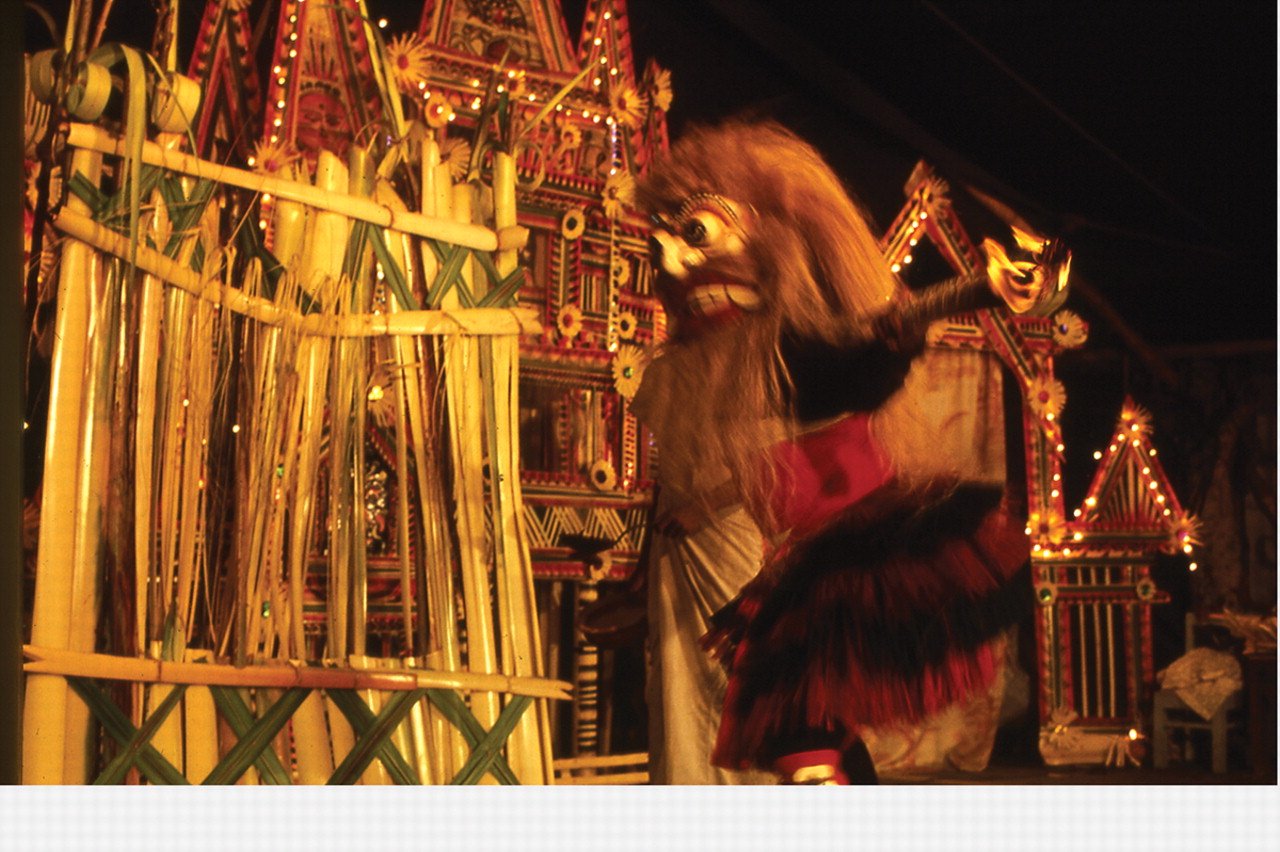
Traditional carved mask is a desired souvenir for a tourist fascinated by distinctive bright tropical color of a wonderful island of Sri Lanka. Painted faces of monsters from fairy tales win hearts with liveliness and straightforwardness of emotions that our rational world so desperately lacks – and your hand surrenders to an impulse to reach for the wallet, owner of a shop is lavish in his praise of your taste… Congratulations: you’ve invited a demon into your house.
Emergence of masks coincides with heyday of animism: having populated forests, fields and rivers with spirits, people had to make arrangements with them somehow. But how to figure out what a non-evinced essence that lacks flesh wants? It was believed that in the course of a ritual messenger of the astral can settle in people and animals but how can one be sure that they’ll agree to leave in the good time upon ceremonial tamtams cease rolling? All kinds of backstabbing can be expected from fleshless guests therefore shamans would put on masks before their special rites suggesting that a spirit settle in them to secure themselves from magic influence.
Art of carving masks emerged in near-shore regions of the south part of the island. Best workshops are concentrated in Ambalangoda town located in between popular resorts Kosgoda and Hikkaduwa. Masks Museum, founded by hereditary craftsman Ariyapala, operates in the city. On the first floor visitors get acquainted with basic principles of makeshift masks production however some details of the craft are still not disclosed and are only transferred from a teacher to an apprentice. On the second floor rich collection of ancient masks made by modern craftsmen is preserved, at that some of the items can be bought at a rather moderate price.
Only Kaduru wood is suitable for production of masks, it is a source of the world’s lightest timber. Properly prepared wood material strikes with distinctive softness and inviolately obeys a chisel. Logs of wood are dried in the sun for some time until latex exudation stops, it is then sawn into wood bars of appropriate size and they are used to make intermediates for future masterpieces.
After primary works, billets are treated with smoke for a week to make them resistant to rot and mildew, also, pungent smell scares away insect-pests. As soon as wood is smoke-dried, one can get to carving a face of a character. Craftsmen from Sri Lanka are virtuosos of drawing tiniest detail of facial expressions using minimal set of tools. Even at a third-rate countryside shop one cannot find two masks with the same expression – lively character and powerful charisma can be spotted in each item.
Multiple-stage technology of painting of wood concludes creation of a magic image. For paint to spread in neat and even layers, timber is meticulously ground and polished, after that primer is applied to the surface of the mask. Delicate tints of saffron and turmeric are usually used as basic colors while selection of accent shades depends on type of the item: religious treatises stipulate unique color palette for each folklore character. Addition of Dorana oil enhances brightness of colors and protects paintings from burning sun rays.
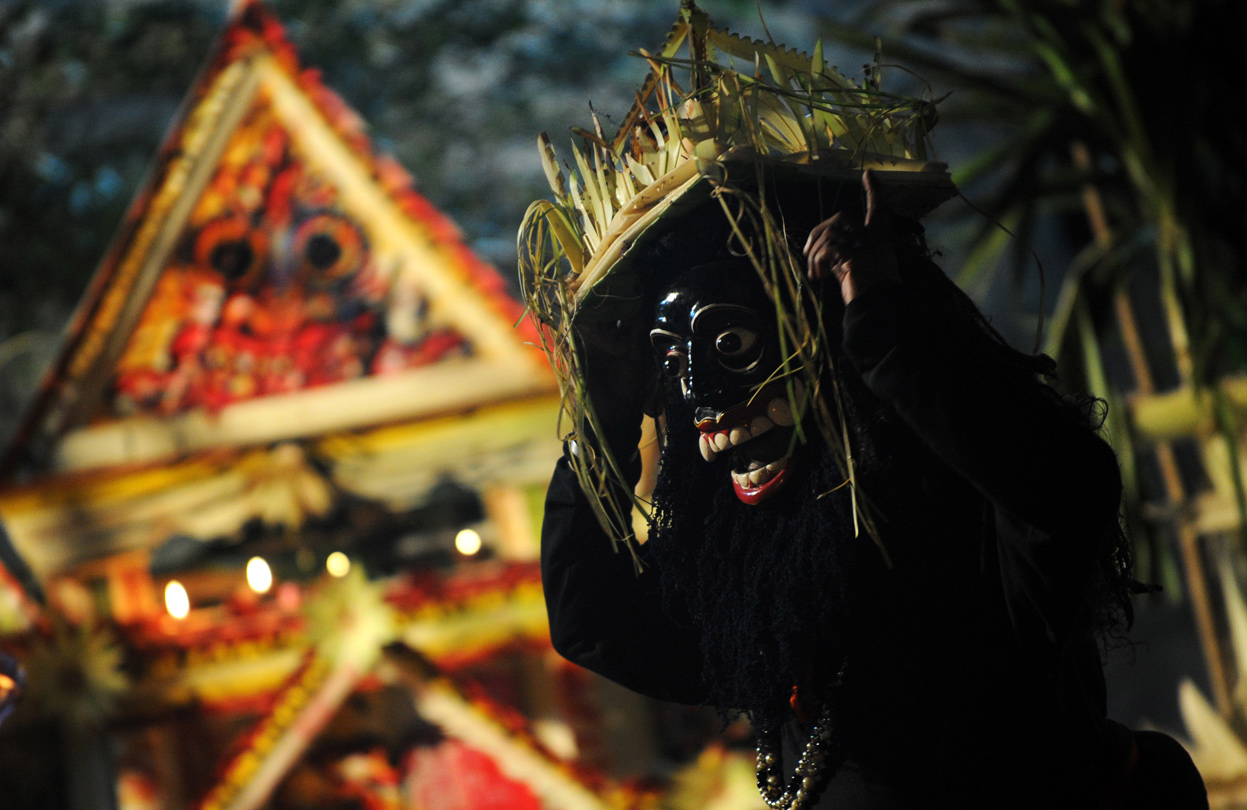
Depending on purpose, Sri Lankan masks are divided into three categories that follow different artistic canons. Sanni masks with sole-colored faces are meant to cure maladies send by demons. Treatment is sorcery of exorcism of a malady spirit. Upon feeling unwell, an islander would commit a sacrifice under supervision of a local shaman and call a demon featured by a man in a mask. Warlock would then ask an evil spirit why he is torturing the sick person and what kind of redeem he wants in exchange to agree to leave the poor sufferer alone. Normally good food, promptly served by other participants of the ceremony, suffices a demon. When full, a demon would perform a rite dance and depart with dignity.
Realistic Kolam masks are used for theatre performances instead of makeup for actors. Legend has it, theatre masks emerged on Ceylon on a whim of King Maha Sammata’s wife who desired to watch a performance with guisers. Theatre didn’t exist back in the days and nobody knew how to fulfill a desire of the yearnful queen. Having heard desperate prayers of her crown-bearing spouse, supreme God Sakra sendt Vishwakarma, the patron of crafts, who taught courtiers acting techniques, thought up a story for staging and carved masks for actors.
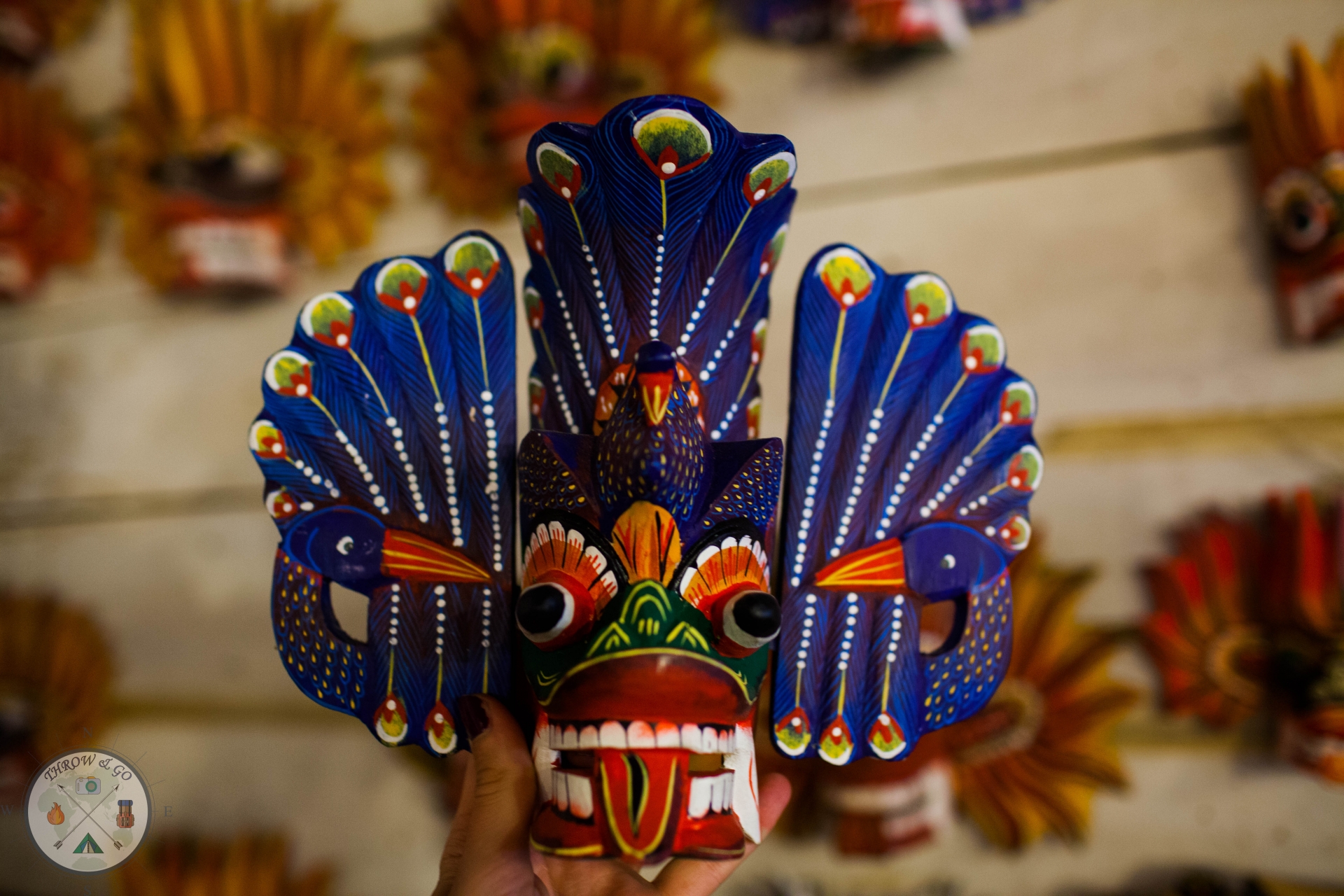
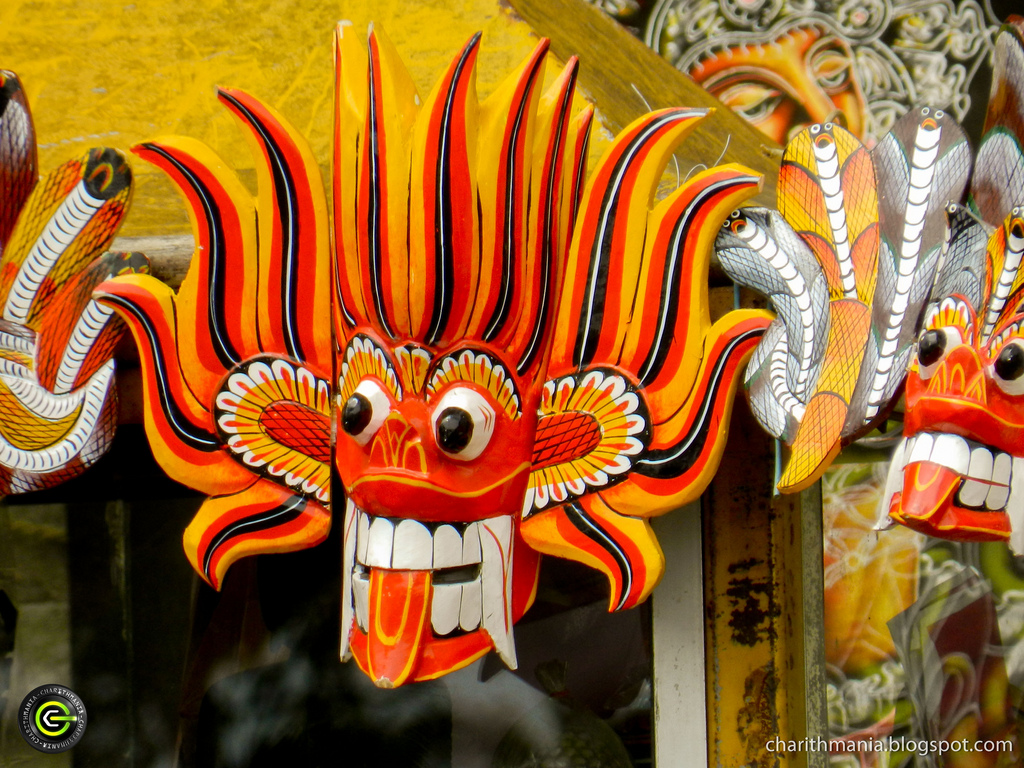
Manufacturing of Raksha requires raving imagination and faultless technique of handling a chisel. Chimeric goggle-eyed monsters with sharp fangs covered in shiny scales that feature Rakshasas – demonic creatures banished from Sri Lanka by prince Rama. Admittedly, islanders aren’t too afraid of demons and eagerly adopt their patronage by decorating walls and doors with Raksha masks. For instance, Rakshasa called Naga crowned with king cobras attracts luck and protects home from natural hazards, robbery and witchcraft. For success in business one should have an image of Ginijal Raksha in the room – fire demon with mane of flames. Mask of the spirit of death Maru Raksha, surrounded by dancing peacocks with wide-open tail, is believed to be the most powerful protective amulet against evil spirits.
Hinduism does not approve of friendship with Rakshashas but Sri Lankans manage to please both Gods and demons preferring not to get involved in epic fights of good and evil but quietly enjoy humble gifts of destiny instead.
The Yakun Natima – devil dance ritual of Sri Lanka
The yakun natima or Traditional devil dance ritual in 1800s in Sri Lanka
Of all the dance rituals, the yakun natima focuses most directly on healing. In Sinhalese thought diseases are either caused by the natural or the supernatural. In the case of the natural, traditional Ayurvedic and/ or medical avenues are pursued. In the case of the supernatural, or where the other systems fail, they have traditionally turned to the edura for aid through such rituals as the yakun natima.
In both cases, however, it is the cause rather than the symptom that must be addressed. And in the case of the supernatural it is the yakku demons that are the cause (6). Collectively, these disease-afflicting demons are known as the sanni yakku. They are a group of demons who, in past battles with the Buddha, were ultimately banished from earth. Living under the loose control of their king Vesamuni (from which the term for mask, vesmuna, is derived), the yakku are unable to appear physically upon the earth, but retain the power to afflict, and through the influence of the Buddha, to heal.
The Eighteen Sanni Yakku
Every demon has an identity, a story. Unlike among the Balinese, where demons often represent types (i.e., hero, villain, clown, etc.), the Sinhalese yakku represent individual demons whose lineages and exploits are recited and commemorated. The masks used in the various rituals are carved to represent particular demons and can, with some exceptions, be specifically identified. Although the yakku. seem limitless in number, there is a core group of eighteen which form the focus for the yakun natima rituals.
Known as the daha-ata sanni yakka, these demons represent specific afflictions, both mental and physical, which commonly afflict the Sinhalese villagers. Although the number eighteen has now become standard, indications are that this number has decreased over time. Nor are the identities of the eighteen consistent. Different areas, or even different communities within the same area, will count different demons among the list.
Paul Wirz, in his seminal work Exorcism and the Art of Healing in Ceylon (1954), lists the following demons and their effects: Kana-sanniya (blindness), Kora-sanniya (lameness/paralysis), Gini-jala-sanniya (malaria), Vedda-sanniya (bubonic plague), Demala-sanniya (bad dreams), Kapala-sanniya (insanity), Golu-sanniya (dumbness/muteness), Biri-sanniya (deafness). Maru-sanniya (delirium). Amuku sanniya (vomiting), Gulma-sanniya (parasitic worms), Deva-sanniya (epidemic disease, i.e. typhoid, cholera), Naga-sanniya (evil dreams particularly with snakes) (7), Murta-sanniya (swooning, loss of consciousness), Kala-sanniya (black death), Pita-sanniya (disease related to bile) (8), Vata-sanniya (shaking and burning of limbs), and Slesma-sanniya (secretions, epilepsy).
Surveys by individuals such as Alain Loviconi and E.D.W. Jayewardene, have demonstrated significant differences between various areas and the impossibility of creating a universally recognised list. One area might include 0lmada sanniya (babbling) and another area Avulun sanniya (breathing difficulties, chest pains). Contemporary ethnographers such as Obeyesekere have also noted the addition of certain more contemporary maladies to the list. For example Vedi sanniya as relating to gunshot wounds, dramatically reflecting the change in times and the adaptability of this indigenous system.
Although there is no single, uniform list or all eighteen demons, certain demons do seem consistent and universal, such as Biri for deafness, Kana for blindness (9), and Golu for dumbness.
Presiding over these eighteen yakku is the demon known as the Kola sanni yakka (10), a composite demon containing and regulating the other eighteen. In the yakun natima it is appeasing the Kola and gaining his benediction that is most important. His origin story, as recorded by Wirz, is as follows:
A certain king left for a great war, leaving behind his queen. He was unaware that she was pregnant. Upon his return he found his wife to be in an advanced state and ready to give birth. A handmaid to the queen, through lies and deceptions, convinced the king that it was not his child but that of the war minister, who had remained behind. In a fury he ordered the queen tied to a tree and cut in two. The child managed to survive, living off the remains of his mother. As he grew, the child vowed revenge on the father.
He gathered poisons from the different parts of the forest and formed them into eighteen separate lumps which transformed into demons. Kola sent these demons into the city and charged them to “capture humans and cause illness through wind, phlegm, and bile”.
The havoc wreaked on the city was awesome. Buddha, sensing this, came to the city and, appearing overhead, ordered Kola and his demons to stop. Angered, Kola attempted to refute the Buddha, vehemently justifying his actions based on the grievous wrongs done to him. But with a “single glittering ray” Buddha subdued Kola and ordered his chiefs to use water to cleanse the city and wash away the demons. Kola persisted in trying to justify his actions and the Buddha ultimately relented, granting Kola and his demons the power to afflict, but charging that they must also heal these afflictions when tribute is paid.
Identities
Accounts and photographs of masked dancers with bulging eyes, tusks, and gaping mouths have long attracted ethnographers and the curious. The result is that European museums boast significant collections of wondrous masks carved of wood with exquisite artistry, depicting a phantasm of creatures. The masks of the yakun natima, befitting their function, are generally gruesome, with distorted faces, cobras (called naga) coiled like crowns atop their heads, eyes bulging and strong protruding noses with flaring nostrils. They are powerful carvings designed to inspire fear, awe, and a recognition of the presence of these supernatural beings in our daily lives.
Although the identities of some demons are difficult to ascertain out of context, many masks can be readily identified by form and colour. Biri-sanniya, the demon for deafness, for example, is consistently depicted with a cobra emerging from one eye and covering the side of the face where the ear would be. This relates directly to the Sinhalese belief that the cobra has no ears and therefore must “hear” with its eyes. Kora sanniya, the demon for lameness/paralysis, is often depicted with the features of one side of the face drawn up, approximating the signs of a stroke (11). Amuku sanniya, the demon for stomach disorders and vomiting, is often depicted with a green face, wide open eyes, and a partially protruding tongue (12).
The yakun natima and other masked dances of the Sinhalese are all based on the concept of appeasement. They acknowledge the influence and power of the yakka as both the cause and the cure. They recite their histories, extol their power, and pay tribute to their prowess. These ceremonies are designed to call forth the “essence” of the offending demon. Through sweet-talk and offerings or through cajoling and threats, the yakka is made to remove the affliction.
Kolam Natima
The kolam natima belongs to a different category of ritualised mask dance than the yakun natima. Today it is rarely practised and has been gradually losing its importance over the last hundred years. The early twentieth century writer Otaker Pertold commented that, even in his day, much of the original import of the dance had been lost, and that on the few occasions that it was still performed it was undertaken by laymen rather than edura or those specifically versed in ritual dances. Because some forty masked characters are involved in this elaborate drama, with commensurate offerings expected for certain devils and demons, Pertold cites the great expense involved in staging a full kolam natima as responsible for its gradual abbreviation.
As a ritual, the kolam natima broadly centres around pregnancy issues. The cravings and desires (dola duka) that often accompany a pregnancy were traditionally viewed with great suspicion, and were believed to be some sort of supernatural possession. The masked dance is thought to have been principally directed against these cravings and to protect the fetus in general.
The origin story and characters depicted in the kolam natima reflect some of this original intent:
The queen of a powerful king was pregnant. As her pregnancy neared term she developed an irresistible craving to see a masked dance performed. So intense was her desire that her health rapidly began to fail. ‘She beseeched her husband, the king, to grant her this wish. The king asked his ministers what should be done, but no one knew what a masked dance was. In his desperation the king pleaded to the god Sekkria, asking that he should reveal what must be done. Hearing his plea, Sekkria instructed one of the four guardian gods, the God of Curiosity, to carve masks of sandalwood and place them in the king’s garden with a book detailing what must be done. In the morning the gardener found masks distributed throughout the garden, some with the faces of devils, others of animals, and others of noble courtiers and ladies. The gardener rushed to the king and told him the news. He and the ministers gathered in the courtyard, discovered the explanatory text and a masked dance was performed immediately for the benefit of the queen.
It is assumed that the mask dance did the job, and that she suffered no more dola duka, and that the infant was a healthy one.
Near the final stages of the performance, as translated by Calloway in 1829, a pregnant woman enters the scene and after much anguish gives birth to a son, exclaiming: “The beauty of the child I have now got is like a flower. His prattle will be pleasant, and he will like much to chew betel [nut].” Care is urged for her son, and the demons and devils that threaten it are placated with offerings.
There is very little structure to the dance itself. Following a brief introduction and a retelling of its origins, the ritual consists primarily of a series of dances and walkthroughs by a set of characters; gods, humans, animals, and devils, each successive character being only loosely connected with what preceded. From the introduction at the court, we move out through the village catching glimpses of village life before moving into the woods, where the threats and ferocity of the animals give way to the terror of devils and demons.
Thus the impact of the kolam natima lies not in its great narrative strength but in the pure spectacle of the masks: the Lasquarine soldier who lost his nose in the great battle of Gampelle; the great Virgin of the Snakes with her radiant face surrounded by coiled cobras; the golden faced and seductive woman with five bodies (13); the greedy moneylender, Hettiya (14); the haggard old man (15) and old woman (16) dressed in rags looking for support from the young villagers; the innocent bullock attacked by a ferocious tiger and a pack of hungry jackals; cavorting monkeys with shaggy beards and gaping mouths (17); the awesome devil Nanda Gere with two devil faces on each side, with gnashing teeth and a body caught in his jaws (18), and Yamma Raksaya, the black-faced devil of death with his long tusks, demon faces flanking his own and coiled naga serpents crowning his head (19).
Construction
Although a brisk trade in masks for tourists has developed in the Ambalangoda area of coastal Sri Lanka, the masks used in the various natima ceremonies were traditionally carved by the edura himself, infusing them with a particular power for the upcoming ceremony. While the edura in his normal walk of life might be a fisherman or farmer, rather than coming from an artisan class, the masks themselves often exhibit a great deal of skill and dexterity in their carving. This reflects the long apprenticeship period that has traditionally been required of all edura, studying under an established figure that may often be the father, uncle, or an elder family member.
Although some of the masks are quite large and complex in their structure, most of those traditionally used in the various natima ceremonies are considered threequarter masks. Strapped to the face, they extend from the middle of the forehead to just below the mouth. This type of lightweight construction makes it easier for the dancer to wear during the often spastic and exaggerated movements executed during a performance which could last up to twelve hours.
Three types of wood are listed as common to mask construction that could vaty depending upon the region and the immediate availability of materials; kaddra (strychnox mux vomica) was prized for its durability (20); eramadu (erythrina india and rukatiana (alsronia scholaris), the latter being considered inferior and known for breaking easily. Divided into blocks, the mask is gradually shaped from the wood. Once the final form is created, the wood is polished using leaves from the mota daliya boodadiya, or korosa trees. Prior to pain g, the polished wood is treated with a t(, clay sealant called allidyu that acts as a gesso and creates a better bonding surface for the pigments to follow.
Although contemporary masks are often painted with commercial pigments, even some of the older masks when they have been repainted reflect this growing trend (21), traditional techniques involve the exclusive use of natural organic and mineral-based pigments. White was derived from makulu clay, green from the leaves of the kikirindiya plant, the ranavara tree, or the ma creeper, blue from the ripe fruit of thebovitiya (22), and yellow from hiriyal orpi ment), or yellow pepper. Black was obtained from charred cotton, and red from cinnabar or a red clay called gurru gal. To protect these pigments the edura would then coat the mask with a lacquer sealant called valicci which was derived from a combination of resins from the hal and dorano trees with beeswax. Hair and beards were simulated through the use of various dyed fibres, elephant hairs, and monkey skins applied directly to the mask.
Nineteenth century and earlier examples preserved in collections retain an amazing vibrancy of colour. An exceptional kolam natima mask of the demon Naga Raksaya was exhibited in the Universal Exposition of 1900 in Paris and is shown here (23). Collected during the middle of the nineteenth century, it is a marvellous example of the strength and durability of the natural pigments used, as well as illustrative of the extraordinary carving talents of the edura
Carved from a single piece of wood with only the small central naga and two ear pendants added, this mask reflects a master ful handling of materials. The painting itself is quite sophisticated with a banding pattern criss-crossing the nose, outlining the mouth and accentuating the eyes. The cinnabar red used for the face glistens through its lacquer sealant. The underbelly of the large central naga, as it executes a graceful arc over the face, is banded and appears very reptilian, as does the crown of three naga on his brow and the coiled naga pend-ants which serve as ears.
The masks of the yakun natima and other dance rituals of Sri Lanka represent a re-pository of a fast-fading culture. Sharing their heritage with a broad range of shaman- based mask cultures of Asia, these masks speak a language which is increasingly fall ing on deaf ears. As the role of the edura becomes increasingly marginalised in Sinhalese society, and education begins to transform traditional concepts of the interaction between the natural and the super-natural, the yakku and the various devils are gradually fading from popular con-sciousness. And while mask carving for tourists and dance performances for the outsider will persist, the fundamental spirit, potency, and vitality of both natima rituals and their masks will sadly be lost. It will therefore be primarily through the older examples, preserved in public and private collections, that future generations will able to recognise the force and the beauty of the devil dance masks of Sri Lanka.
The popular Kandyan dances have brought Sri Lankan traditions to a wider international audience, and revealed the many more mythological legends in this ‘land of a thousand dances’. With the starting point of Galle’s historic mask-carving hub, Ambalangoda, a dramatic voyage linking to exorcism and local demons unravels.
The many varieties of Sri Lankan dance each have their own cultural resonance, and contemporary meaning; ves dance, the most popular of Kandyan dances, with its regal headgear and elaborate traditional costumes, evolved from an ancient purification ritual. Pantheru, on the other hand, are dance rites celebrating triumph in the battlefield. But down in the Sri Lankan low country, things often get far more sinister. Along with traditional comic folk plays like Kolam dances, come Sanni Yakuma, healing liturgies used to liberate people from their sickness — physical or psychological — caused by unscrupulous, hideous demons.
The Art of the Grotesque: The Ariyapala Mask Museum
The Ambalangoda Mask Museum, containing the museum’s main space, a workshop and a small library loaded with anthropological material on masked performances, has been a popular cultural stop in Sri Lanka since 1987. Officially named Ariyapala & Sons, it reflects the efforts of a family to preserve the traditions of masks and dancing over the course of five generations. The family has single-handedly undertaken the task of recreating a complete collection that mirrors the rich tradition of the coastal areas — a total of 120 masks that, due to the lack of space, can’t unfortunately all be displayed in the museum. It’s a free, magical ride to the Southern coast’s past, supplemented by the in-depth commentary of the English-speaking guides and enhanced by dioramas, giving a visual display of how they were used in performances.
One can see the craftsmen working their way through the grotesque expressions of the villainous demons and the comic grimaces of the good-natured kolam folk — which you can find for sale in the shop. Prices are decidedly high, but though cheap reproductions are abundant around Sri Lanka, these are true originals. They are made out of the local Kaduru tree (nux vomica) timbre, through a lengthy process that involves seasoning and durable coloring. Most importantly, each mask is linked to a particular folktale and characters with which carvers have to mentally connect — a task that often requires a much wider traditional and philosophical education and understanding.
Eighteen Degrees of Separation: How to Escape a Demon with Sanni Yakuma
From deafness to cholera and the fear of death, eighteen physical and psychological diseases were attributed to the local demons, which are known as sanni in Sinhalese tradition, and these were exorcised by eighteen equivalent masked dances, called ‘sanni yakuma’. The evil so expressively depicted in apotropaic Sri Lankan masks was exorcised in three ritualistic steps: a specialist would lure in a demon with offerings, upon his arrival, the ‘doctor’ would make him promise to leave the patient’s body — until, finally, he was politely sent away, performing one last dance. In Sri Lankan dance these demons would each be depicted through eighteen wood-carved faces, accompanying which would be the chief of Sanni, himself depicted in the so-called Medicine Masks (Maha Kola).
Kolam masks were designed to perform comic folk Kolam dances in the West and South-West region of the country — and the Ariyapala Wijesuriya family is among the few that has maintained this tradition in the region. Legend says these masks were created to entertain the pregnant wife of King Maha Sammaha, the first king of human beings, for which purpose they were sent, along with lyrics, to the royal garden by God Vishvakarma (the God of Craftsmen). In order to stay faithful to ancient mythologies, every dance includes the masked King & Queen, who overlook the scene. Albeit benevolent, Kolam masks can be equally, and hilariously, grotesque. The dances also reflect a more down-to-earth side of Sinhalese tradition, narrating the lives of royal servants.
Raksha masks are the final facet of the Kolam ritual, and they are a tribute to the Rakshasas, a race that earlier ruled Sri Lanka and could assume 24 different forms. Unfortunately, only a few of those are performed — among them, the Cobra (Naga Raksha), the Bird (Gurulu Raksha) and, spookily enough, the Demon of Death (Maru Raksha).
A Raksha mask is a mask that Sri Lankans use a lot in festivals and cultural dances. Raksha means “demon” and the masks are apotropaic which means that it is intended to ward off evil. They are painted in vibrant colors, with bulging eyes and protruding tongues and they depict various types of demons. Raksha masks are thefinal aspect of the Kolam ritual, and they are a tribute to the Rakshasas, a race that earlier ruled Sri Lanka and could assume 24 different forms. But only a few of these forms are performed, some of which are Naga Raksha (cobra mask), Gurulu Raksha (Mask of the Bird) and Maru Raksha (Mask of the Demon of Death).
This ritual has been created to heal the sick, and so this is how the Raksha masks were created. The Raksha masks were first made for the uses of those rituals. The witch doctor wears these masks to imitate the imaginary faces of the devils which were known as the cause for the disease. The doctor then dances to the rhythm of the drum and wore the demons away. Raksha masks were and are also used to perform Raksha dances in Kolam Maduwa. According to legends, Sri Lanka was earlier ruled by a race called Rakshasas whose king was Ravana of the Ramayana. Now the Raksha masks are used in a lot of festivals, cultural dances and are also sold to the tourist trade and institutions for display.
Different types of masks have different meanings. Some of these types of masks are religion, ritual, secular, exorcist and exorcist with ritual overtones. These masks also have different uses to them like healing or spiritual uses. They are made to represent different types of demons. The masks can be different shapes and sizes, but the looks of the masks depend on the ritual or dance it is used in.
Mask carving is a local tradition at the southern coastal region of Sri Lanka in Ambalangoda. Ambalangoda is known for their traditional mask carvings and dancing. The present institution known as Ariyapala & Sons which passed through their fifth generation mask carving and dancing is very cultural in Ambalangoda.
The Raksha masks are nearly entirely made out of a light, soft wood called kadura, which is smoke-dried before the mask is carved, with a hollow inside so you can put the mask on your face. Other material are used for additional details. The teeth are made from shells and the eyes from glass. Often the eye openings are left bare to allow the wearer’s eyes to be seen, and this gives an appearance of real life to the mask. Color had an immense importance and there are prescribed color-schemes or masks. The older masks are found in the color or red, yellow, black, white and sometimes a dark green obtained from mixing yellow and black. Blue was used very rarely.
The color of the masks usually represent the color of the demon which they believed it looked like. The masks often had the same shape style, which was long, narrow and pointy. Facial expressions on the mask are quite strange. Some would look foolish whilst others intimidating. Intimidating masks would have sharp, pointy teeth with bulging eyes while foolish masks would have less intensifying eyes and smiling with human-like teeth.
Fire
The Ginidella Raksha mask is a Raksha mask which is means its job is to ward off evil. This mask is representing the emotion anger which is why the colors are red, orange, and yellow. The patterns on the ears are warding off all evil. The patterns on the ears and the face really draw your attention which the Sri Lankan people found really important.
Snake
The Naga Raksha mask, also known as the Snake Demon, uses a lot of colors and patterns to it. The most noticeable and attractive pattern is the hair which is shaped into cobras, therefore the name Snake Demon. It has a very long Tung to smell its enemies and the teeth to eat them which in this case are the Sri Lankan people.
Peacock
The Peacock mask is supposed to bring peace and harmony, therefore the bright beautiful colors white, and blue. A peacock is also know to bring peace and harmony. This mask also wards off evil spirits and ghosts.
There were different types of masks that had different meanings. These types of masks are:
1. Religion/magical
2. Ritual/spiritual
3. Secular/spiritual
4. Exorcistic
5. Exorcistic with ritual overtones
The masks have different uses to them, like spiritual or Healing uses. THe masks of Sri lanka(no matter what they are used for) are made to represent different types of demons. The difference in the masks is color and aesthetics.
One mask can have a face of a bird, another can be a face with big teeth and tongue sticking out. The looks of the mask depends on which ritual/dance it is used in
The masks come from originally from South East India. Not only Sri Lanka has strong Indian cultural influences, but also Cambodia, Burma, Indonesia and Thailand do.
The Sinhalese further developed the masks into their own characteristic styles. Sinhalese people, an ethnic group which is native to the island of Sri Lanka. Nearly 75% of Sri Lanka’s population are Sinhalese with over 15 million people.
Sri Lanka is well-known for worshipping demons, hence they created a variety of devil masks for ungodly practices. Masks in Sri Lanka are also based on mythological, animal-spirit and human figures for the sole purpose of rituals.





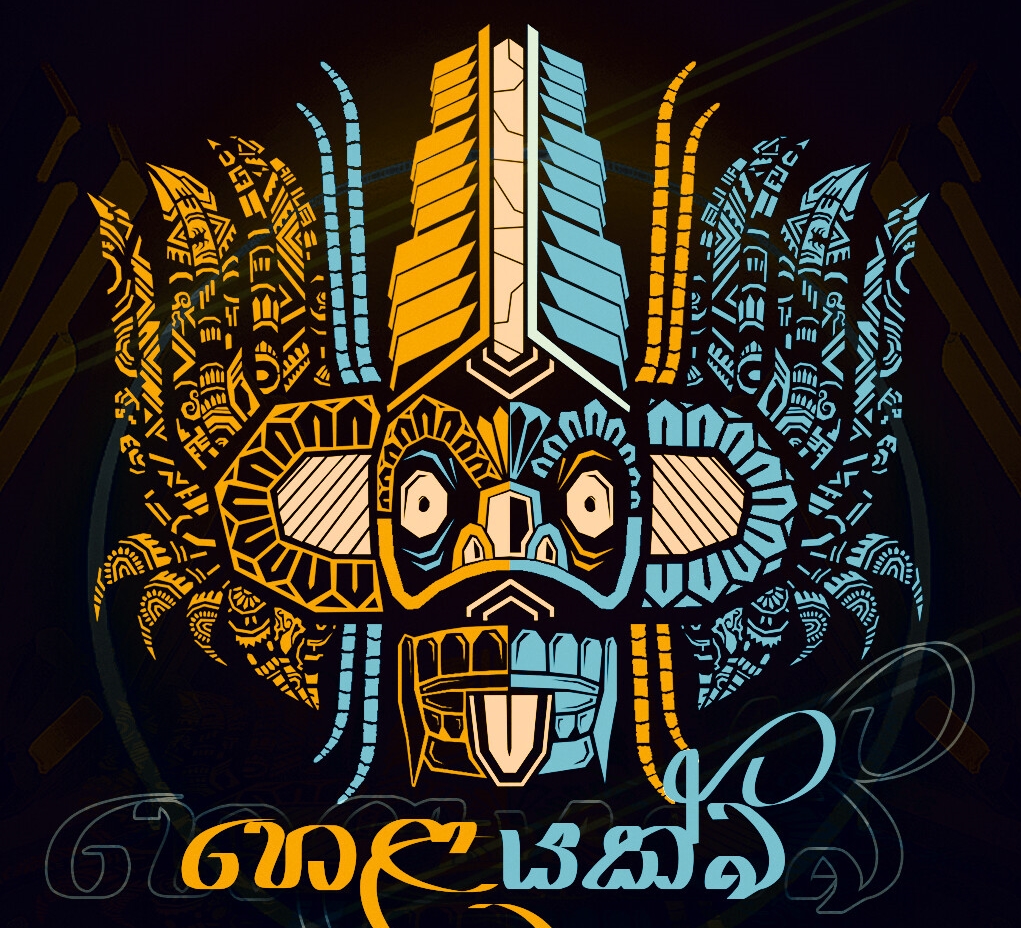
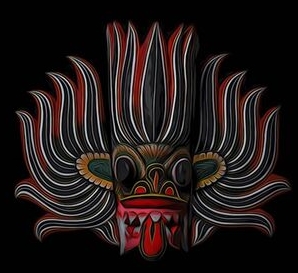
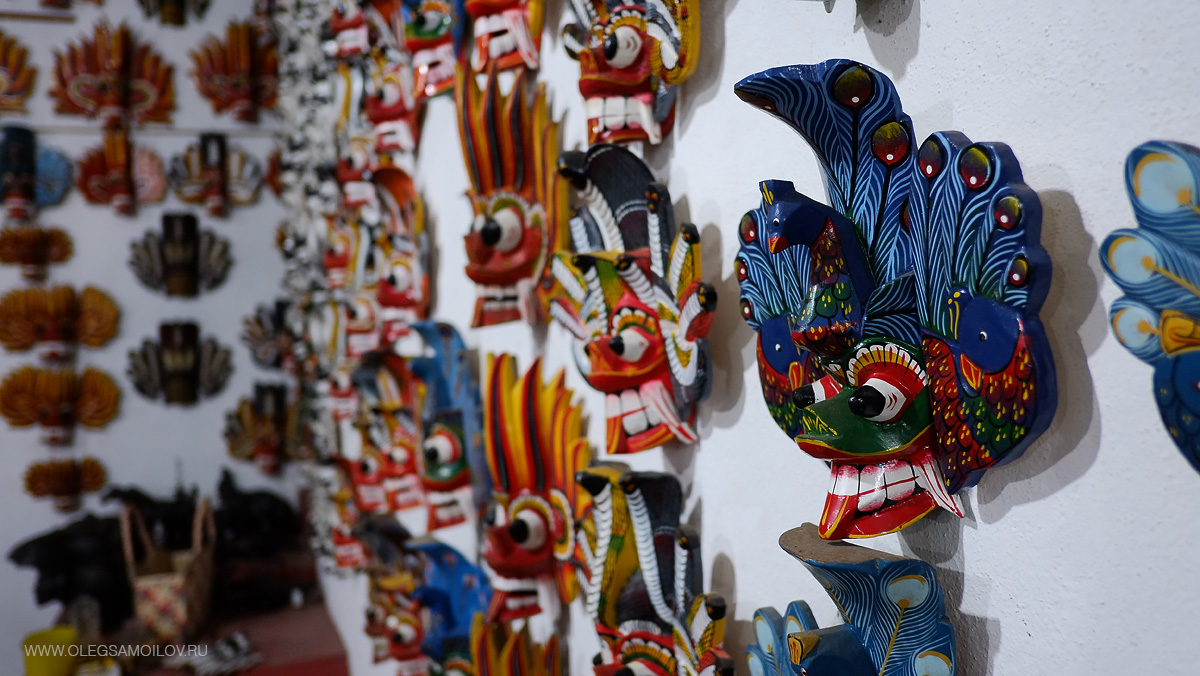 Art of carving masks emerged in near-shore regions of the south part of the island. Best workshops are concentrated in Ambalangoda town located in between popular resorts Kosgoda and Hikkaduwa. Masks Museum, founded by hereditary craftsman Ariyapala, operates in the city. On the first floor visitors get acquainted with basic principles of makeshift masks production however some details of the craft are still not disclosed and are only transferred from a teacher to an apprentice. On the second floor rich collection of ancient masks made by modern craftsmen is preserved, at that some of the items can be bought at a rather moderate price.
 Depending on purpose, Sri Lankan masks are divided into three categories that follow different artistic canons. Sanni masks with sole-colored faces are meant to cure maladies send by demons. Treatment is sorcery of exorcism of a malady spirit. Upon feeling unwell, an islander would commit a sacrifice under supervision of a local shaman and call a demon featured by a man in a mask. Warlock would then ask an evil spirit why he is torturing the sick person and what kind of redeem he wants in exchange to agree to leave the poor sufferer alone. Normally good food, promptly served by other participants of the ceremony, suffices a demon. When full, a demon would perform a rite dance and depart with dignity.
 Manufacturing of Raksha requires raving imagination and faultless technique of handling a chisel. Chimeric goggle-eyed monsters with sharp fangs covered in shiny scales that feature Rakshasas – demonic creatures banished from Sri Lanka by prince Rama. Admittedly, islanders aren’t too afraid of demons and eagerly adopt their patronage by decorating walls and doors with Raksha masks. For instance, Rakshasa called Naga crowned with king cobras attracts luck and protects home from natural hazards, robbery and witchcraft. For success in business one should have an image of Ginijal Raksha in the room – fire demon with mane of flames. Mask of the spirit of death Maru Raksha, surrounded by dancing peacocks with wide-open tail, is believed to be the most powerful protective amulet against evil spirits.
 Hinduism does not approve of friendship with Rakshashas but Sri Lankans manage to please both Gods and demons preferring not to get involved in epic fights of good and evil but quietly enjoy humble gifts of destiny instead.